

Nusa Penida’s coral reefs are famously rich in marine life, it’s home for hundreds of coral species and reef fish. They attract divers and support fishing communities. Sadly, decades of damage have “turned biodiverse coral reefs into unstable rubble”. Their main threat are:
- Coral bleaching: Periodic heatwaves have bleached large reef areas.
- Overfishing: Destructive fishing methods like dynamite from the past.
- Pollution: Runoff, sewage and plastic enter the water.
- Tourism impacts: Careless diver and snorkeler break corals.
- Climate Change: Rising temperature and ocean acidification stress the reef.
Threse stresses greatly weakened reef health. Over 90% of its coral reefs have been impacted by various local activities. Especially, in Nusa Penida with rapid tourism growth has outpaced waste management, further threatening reefs.
This is where our Conservation team take action to start to restore the reef from 2018. Led by Andrew Taylor. Blue Corner uses a combination of structural stabilization and biological propagation: installing metal frames and mesh to stabilize rubble, cultivating fragments in coral nurseries area, and transplanting many coral species back to reef. Training programs have involve students, dive tourist and volunteers. Early results show the sites’s hard coral cover climbing to 35-40%. We planted 40 corals species so far. Not only reef, fish biomass also recovered, even reef sharks have been observed using our structure as a nursering ground.
Methods: How Blue Corner Restores the Reef
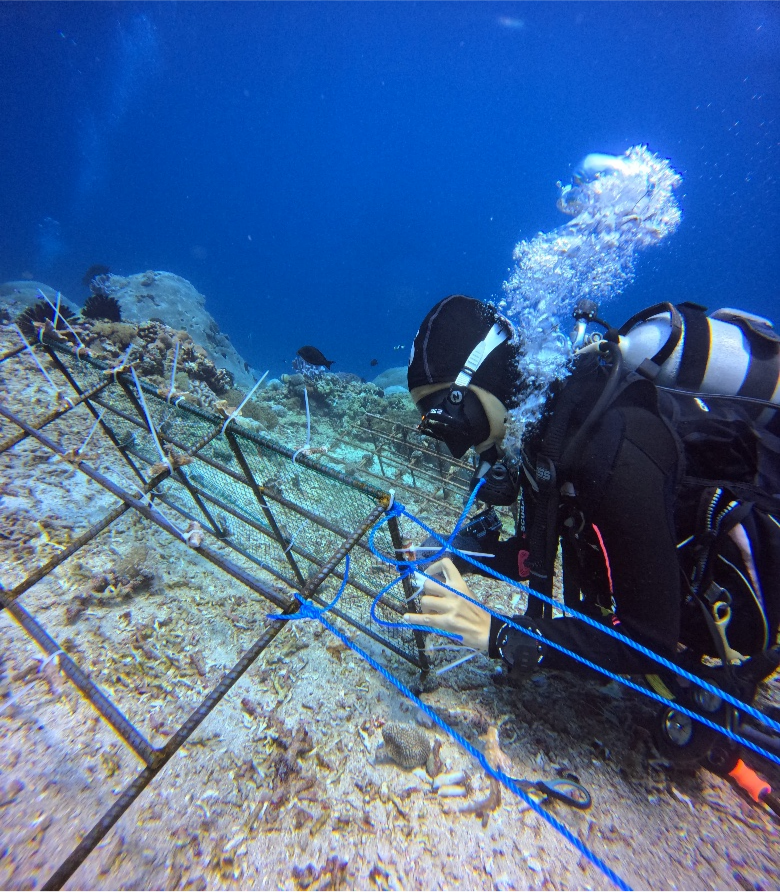
Combination between physical restoration and biological restoration. Key methods include:
- Structural stabilization: Metal frames and wire mesh net are installed on the rubble seafloor. The structures deployed onto restoration sites along the natural reef crest, terraced down the slope, and clustered within reef flat. This physical framework recreated the reef’s topography and stops rubble from smothering new coral recruits.
- Coral Nursery & Outplanting: Blue Corner established nurseries to grow coral fragments instead harvesting from the healthy parent stock. Coral fragments attached to lines and harvested until large enough. Other than fragments from nursery, we also use corals of opportunity (broken pieces but healthy coral from nearby reef then transplanted onto the metal frames. In between frames, coral been planted using rope method to increasing coverage.
- Monitoring & Research: Continuous monitoring to maintain the progress of coral reef growth. We also run experiment comparing coral growth on single species vc multi species. Single species grow faster than multi species, but mixed frame attracted more other organism and increase diversity.

Measurable Outcomes:
- Species Planted: Over 40 coral species have been transplanted and many more have naturally recruits.
- Coral Growth: Single species coral had higher growth and survival rates than multiple species.
- Coral Cover: Hard coral cover increased rapidly on the restoration site.
- Biodiversity: On multi species frame found that natural settlement increased like algae, sponges, and soft corals. Over time, fish diversity will rebounded as well.
- Fish & Megafauna: Recovering fish communities, juvenile reef sharks been born and nursering in our frames, indicating the habitat has regained sufficient complexity and prey.
Ecological and Socio Economic Benefit
Ecological Benefit: By rebuilding reef structure, we start the ecosystem recovery. The transplanted coral provide living habitat and feeding grounds. This also stabilize the rubble and allows other organism to live. The restored reed also contributes to resilience by producing coral larvae that can repopulate nearby reef by itself.
Socio Ecomicic Impacts: We work directly involves the community. The project emplys local marine biologist and train numerous interns and volunteers. Conservation workshops attract tourist and students, which can support local eco tourism.
Challenges and Recommendations
The topography of some areas in Nusa Penida consist of reef slope, which worsens the situation, as expanding rubble from shallow parts can slide downward and damage deeper coral reefs. Funding and volunteer can be a limited, and we relies on donation, as monitoring and maintaining numerous frame is labor intensive.
What we do to overcome the limitation is:
- Train and paying local marine biologist to ensure continuos site care.
- Prioritzing plant fast growing coral to quickly built reed structure while adding diversity over time.
- Involve tourist in restoration project to increase the awareness and workforce.
- Integrating into MPA management plans with government and NGOs.
Call For Action
Blue Corner work shows that committed community action can revitalize reeds. You can help and support reef friendly practice and contributing to restoration project. Divers can choose eco friendly tours, and adopt coral frame through projects like Blue Corner’s. Evry donation helps scale up restoration.
Source:
Burke, L., Reytar, K., Spalding, M., & Perry, A. (2012). Reefs at risk revisited in the Coral Triangle. World Resources Institute.
Marine Life & Environmental Threats (Coral Triangle Center, n.d)
Nusa Penida Coral Reef Restoration Project (Blue Corner Conservation, n.d)
Taylor, A. (2019). Nusa Penida Coral Reef Restoration Site