

Inside Blue Corner’s reef restoration program and what seven years of work looks like underwater
Reef sharks are using our restoration frames as nursery grounds. Hard coral cover on our restoration sites has climbed to 35 to 40 percent. We have transplanted over 40 coral species back onto reefs that were, not long ago, little more than rubble. These are not projections. This is what seven years of hands-on coral restoration work on Nusa Penida actually looks like.
Nusa Penida’s coral reefs are among the most biodiverse in Indonesia. They are home to hundreds of coral species and reef fish, they support local fishing communities, and they are a large part of why divers come here from all over the world. They are also under serious and ongoing pressure, and the damage built up over decades does not fix itself.
This is why Blue Corner started its reef restoration program in 2018, led by our conservation team. Here is what the problem actually looks like, what we are doing about it, and how you can be part of it.
What Is Threatening Nusa Penida’s Coral Reefs?
Over 90 percent of Nusa Penida’s coral reefs have been impacted by a combination of local stressors and broader climate pressures. The result, in the words of reef scientists, is biodiverse coral reefs turned into unstable rubble. The main causes are not mysteries.
Coral bleaching is the most visible. Periodic marine heatwaves push water temperatures beyond what coral tissue can tolerate, causing the coral to expel the algae living in their tissue and turn white. If temperatures stay elevated long enough, the coral dies. With climate change driving ocean temperatures higher and bleaching events more frequent, this is the threat that keeps growing.
Ocean acidification compounds the problem. As the ocean absorbs more CO2 from the atmosphere, it becomes more acidic, which slows coral growth rates and weakens the calcium carbonate structures that make up the reef.
Locally, the damage came from overfishing and destructive fishing methods used in the past, including dynamite fishing, which physically shattered reef structure. Pollution from runoff, sewage, and plastic also enters the water around the island. And as tourism to Nusa Penida has grown rapidly, careless divers and snorkelers breaking coral has become a meaningful and
largely preventable source of damage. Waste management infrastructure has struggled to keep pace with tourist numbers, putting additional pressure on the surrounding marine environment.

How We Restore the Reef: Methods and Approach
Blue Corner’s reef restoration program combines physical reef reconstruction with biological propagation. We don’t just plant coral. We rebuild the structure the coral needs to survive on, and then we grow and transplant the coral back onto it. The approach has three main components.
Structural Stabilisation
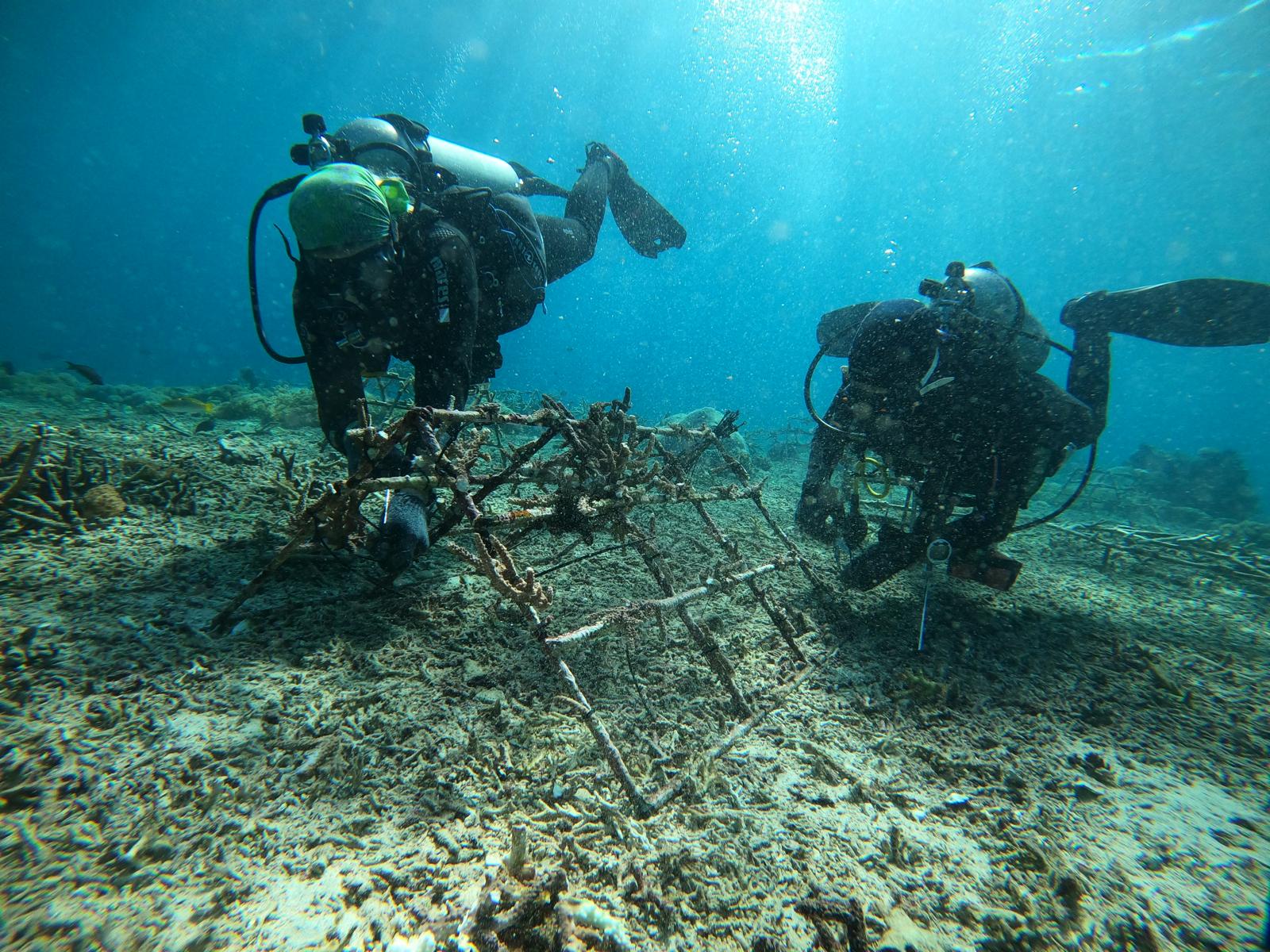
The first step on a degraded reef is stabilising the rubble. Loose rubble fields shift in surge and current, smothering any coral recruits trying to settle. We install metal frames and wire mesh net across the rubble seafloor, deployed along the natural reef crest, terraced down the slope, and clustered within the reef flat. This physical framework recreates the reef’s topography, stops rubble movement, and gives coral larvae and fragments something solid to attach to. It is essentially rebuilding the skeleton of the reef before replanting the living tissue.
Coral Nursery and Outplanting
We established nurseries to grow coral fragments without harvesting from healthy parent stock on the reef. Fragments are attached to lines and grown out in the nursery until they reach a size suitable for transplanting. We also use corals of opportunity: broken but healthy coral pieces found on the seafloor nearby, which would otherwise die, collected and transplanted directly onto the frames. Between frames, we use the rope method to increase coverage across a wider footprint. Each outplanting adds to the density and diversity of the restoration site.

Monitoring, Research, and Citizen Science
We monitor the sites continuously to track coral growth, survival rates, and ecosystem recovery. We have also run experiments comparing single-species frames against multi-species frames. Single-species coral grows faster and has higher survival rates in the short term. Multi-species frames attract more associated organisms, including algae, sponges, soft corals, and a wider variety of fish, and show greater biodiversity gains over time. Both approaches have a place in a well-designed restoration program.
Our training and citizen science programs have involved local marine biologists, dive tourists, university students, and conservation volunteers. If you want to get involved in coral restoration in Indonesia, this is a practical way to do it with direct, measurable impact.
What the Results Actually Look Like
Hard coral cover on our restoration sites has increased rapidly since work began and currently sits at 35 to 40 percent, up from near zero on the most degraded sections. Over 40 coral species have been transplanted and many more have naturally recruited to the frames over
time, meaning the reef is beginning to regenerate on its own.
Fish diversity has rebounded on and around the restoration structures. The most striking indicator is the juvenile reef sharks. They have been observed using our frames as nursery habitat, which tells us something important: the restored reef has regained enough structural complexity and prey availability to support apex predator reproduction. That is not something you see on a rubble field.
On the multi-species frames, natural settlement by sponges, soft corals, and algae has increased organic complexity beyond what we planted. The reef is starting to do some of the work itself.

Why It Matters Beyond the Reef
Restoring reef structure does more than produce coral cover statistics. The transplanted coral provides living habitat and feeding grounds for hundreds of species. Structurally stable reefs also produce coral larvae that can drift and naturally repopulate nearby damaged areas, extending the reach of restoration work beyond the sites themselves. A recovering reef is also a more resilient one, better equipped to survive future bleaching events.
There is also a direct community benefit. The project employs local marine biologists and has trained numerous interns and volunteers from across Indonesia. Conservation workshops attract tourists and students, contributing to local eco-tourism in a way that supports the island’s economy without adding to the environmental pressures that mass tourism brings. Sustainable dive tourism and reef restoration are not in competition. Done well, they reinforce each other.
What Makes This Work Difficult
The topography of parts of Nusa Penida works against us. Rubble from shallow reef sections can slide downslope and damage deeper coral that is still healthy. Monitoring and maintaining many frames across multiple sites is labour-intensive work, and funding and volunteer capacity are always limiting factors. We rely on donations and conservation fees to keep the program running at scale.
We manage this by training and employing local marine biologists who can provide consistent, year-round site care rather than relying on short-term volunteer cycles. We prioritise fast-growing coral species to build reef structure quickly and then layer in diversity over time. We involve tourists in the restoration work directly, which increases both the workforce and the awareness of the people visiting the reef. And we are working toward integration with Marine Protected Area management plans through collaboration with local government and NGOs.

How You Can Help Restore Nusa Penida’s Reefs
Blue Corner’s work shows that committed community action can genuinely turn degraded reef back into functioning ecosystem. But it requires continued effort, funding, and people who care enough to show up.
If you are diving or snorkelling in Nusa Penida, choose operators who practice and promote reef-safe diving. Buoyancy control matters. Not touching the reef matters. The difference between a careful diver and a careless one, multiplied across thousands of dives a year, is measurable in coral cover.
You can adopt a coral frame through Blue Corner’s program, contributing directly to the restoration sites and receiving updates on how your coral is growing. You can join us as a conservation volunteer, either as part of a dive trip or a longer-term internship. And if you want to support the work from a distance, every donation goes directly to maintaining the frames, training local biologists, and expanding the restoration footprint.
The reef is recovering. It needs help to keep going.
Sources
Burke, L., Reytar, K., Spalding, M., & Perry, A. (2012). Reefs at Risk Revisited in the Coral Triangle. World Resources Institute.
Coral Triangle Center (n.d.). Marine Life and Environmental Threats.
Blue Corner Conservation (n.d.). Nusa Penida Coral Reef Restoration Project.
Taylor, A. (2019). Nusa Penida Coral Reef Restoration Site.
Dive and Restore with Blue Corner Dive Penida
Blue Corner Dive Penida is Nusa Penida’s first conservation-focused dive centre, founded by Jason Fondis. Every dive you book with us contributes to ongoing reef restoration, manta ray conservation, sea turtle ecology, and reef monitoring. PADI courses, fun dives, and conservation dives all run from our base on the northern coast of the island.
Website: bluecornerpenida.com
Google Maps: maps.app.goo.gl/Ba4gJo5RFg1ANTGb8
WhatsApp: +62 812 3655 5503 | Email: penida@bluecornerdive.com
Instagram, TikTok, Facebook & YouTube: @bluecornerpenida